Action and Reaction: Every Choice Has a Consequence
From Sport to Everyday Life — Learning to Make Better Choices
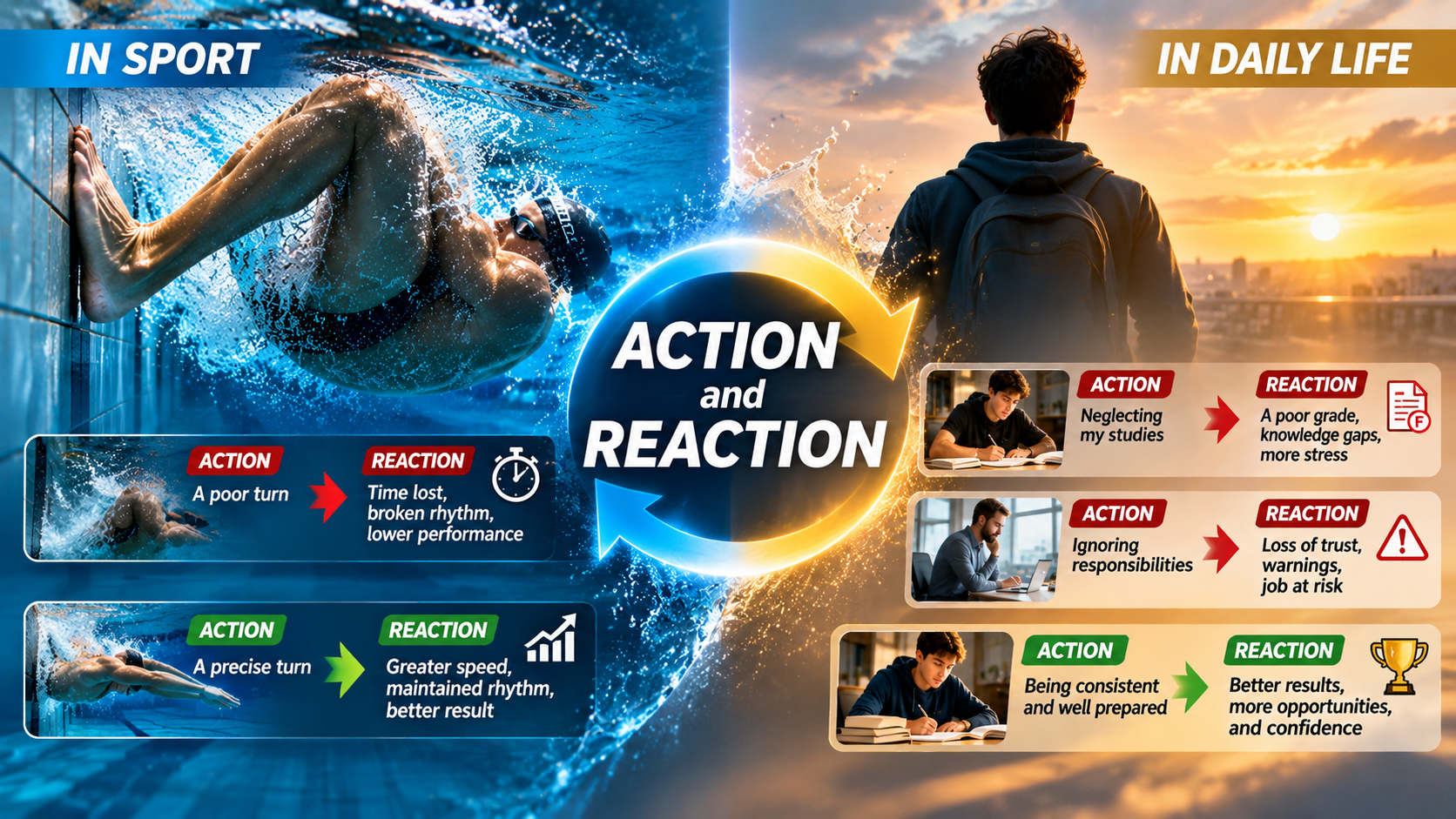
Every action we take, whether in the swimming pool or in everyday life, has an impact. It is not simply about the physical law that links a force to an opposite movement, but about a deeper principle involving responsibility, foresight and personal growth: every action produces a reaction, which can be either positive or negative.
Understanding this connection does not mean living with constant anxiety about the outcome. It means learning to pay attention to what happens immediately after a decision. This is an important step towards maturity: learning to direct our actions towards choices that, with the same level of effort, involve fewer risks and greater benefits.
The Lesson from the Pool: The Freestyle Turn
In sport, the relationship between an action and its consequence is often immediate, almost unforgiving in its clarity. Let's take swimming, particularly a freestyle race. You may have worked on your start, maintained a solid pace and managed your energy well, but if you make a mistake during the turn — approaching the wall incorrectly, losing your body position or pushing off poorly — the consequence is tangible: you lose valuable fractions of a second, disrupt your rhythm and risk compromising the entire race.
Conversely, a turn executed with precision, timing and control can transform a critical moment into an opportunity to accelerate again. In sport, those who develop awareness do not simply focus on “working hard”; they learn to understand the relationship between a technical action and the effect it has on overall performance.
From Sport to Everyday Life: Limits and Uncertainty
The same mechanism accompanies us in everyday life, although the consequences often take longer to emerge and can be more complex:
- At school: neglecting your studies or preparing superficially can lead to poor grades, gaps in knowledge or the feeling of constantly falling behind. By contrast, a consistent approach creates greater security and peace of mind.
- At work: ignoring shared rules, underestimating responsibilities or being unreliable can result in warnings, loss of trust or, in the most serious cases, losing your job.
However, real life does not operate according to an absolute mathematical formula. There are always grey areas: unexpected events, coincidences, luck or bad luck, and external factors that we may not have anticipated.
That is why the most appropriate word is often might. You might make a mistake during a turn and still recover because of an opponent's mistake. You might study very little and happen to encounter a question you know well. Equally, you might do everything correctly and still face an unexpected situation.
These variables do not diminish the value of our choices. They simply remind us that control is never absolute, while intention and preparation remain the most solid foundations on which we can rely.
The Maturity of Awareness
There will never be a perfect action-and-reaction formula, because reality is too dynamic and unpredictable to be reduced to a rigid rule. Nevertheless, becoming aware of this mechanism can change the way we approach life.
It means pausing for a moment before acting and asking ourselves: What might this choice set in motion?
It means not passively accepting events, but taking responsibility for our own part, reducing unnecessary risks and developing actions that are more thoughtful, sustainable and beneficial.
Ultimately, this awareness is what allows us to live with greater balance and perform sport more effectively: not by pursuing impossible perfection, but by learning to choose more carefully what lies within our control.
Every choice sets something in motion.
We cannot control everything that happens after a choice, but we can make choices that increase the likelihood of positive outcomes.